How Can Businesses Measure the ROI of SEO, AEO, and GEO in a Unified Marketing Strategy?
Introduction: Why Measuring Digital Marketing ROI Matters
Businesses invest in digital marketing to achieve meaningful outcomes, such as increasing brand awareness, generating qualified enquiries, acquiring customers, and growing revenue. However, understanding which activities contribute to these results can be challenging when multiple marketing channels operate together.
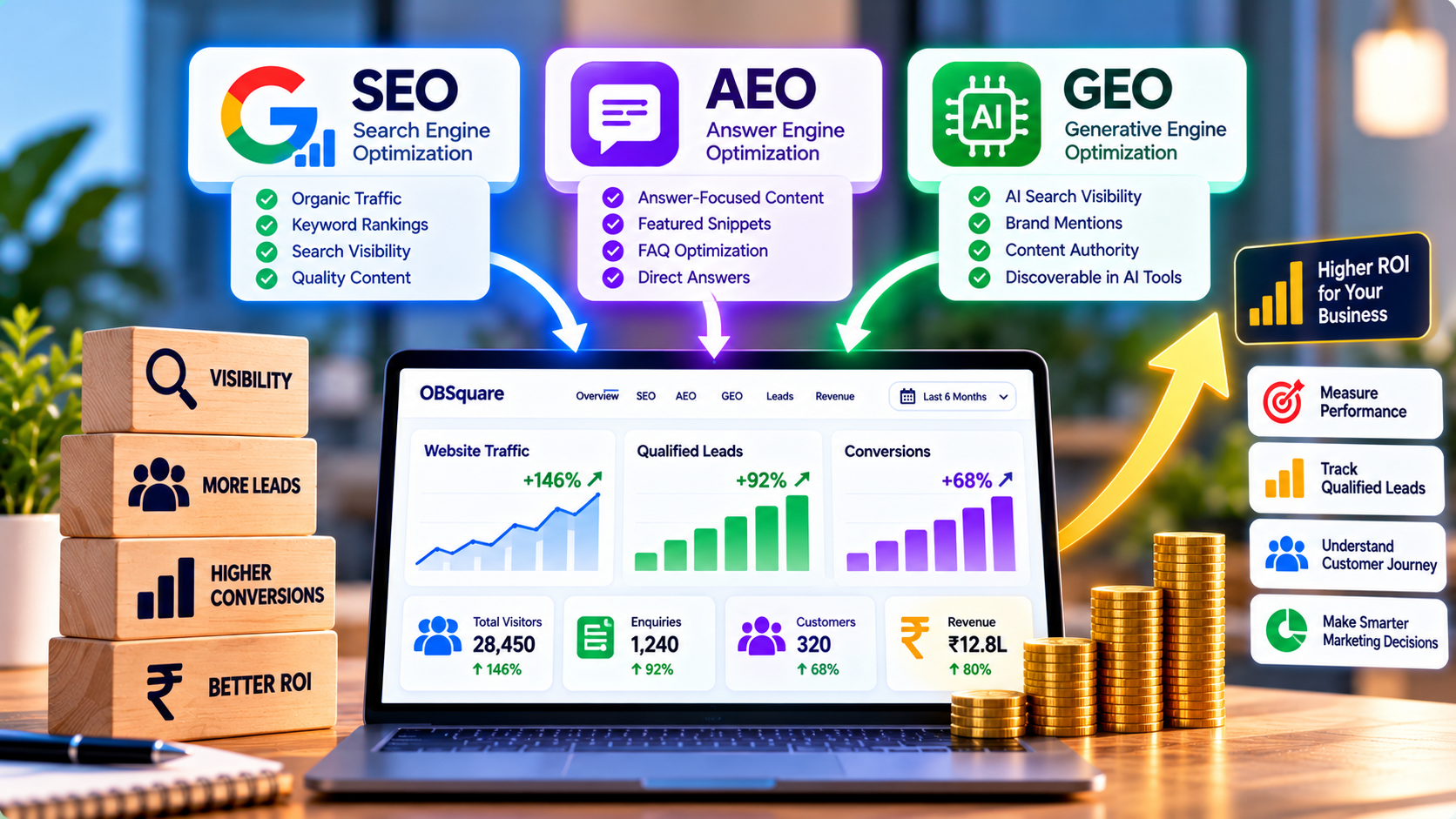
Search Engine Optimization (SEO), Answer Engine Optimization (AEO), and Generative Engine Optimization (GEO) each support online discovery in different ways. SEO focuses on organic search visibility, AEO helps make content useful for answer-oriented search experiences, and GEO focuses on improving how clearly and credibly a brand's information can be understood in AI-powered discovery experiences.
Although these strategies have overlapping goals, they should not all be measured using the same individual metric. Businesses need a unified framework that connects visibility, website engagement, enquiries, conversions, and revenue.
The objective is to understand whether marketing investment is contributing to business outcomes and where improvements are needed.
1. Understand the Difference Between SEO, AEO, and GEO
Before measuring ROI, businesses should define what each strategy is intended to accomplish.
SEO: Search Engine Optimization
SEO aims to improve organic visibility through relevant content, technical website improvements, site structure, and useful information that meets search intent.
Useful indicators include organic clicks, impressions, relevant keyword performance, organic landing-page visits, and qualified enquiries.
AEO: Answer Engine Optimization
AEO focuses on making content clear, direct, and useful for people seeking answers through search features and answer-oriented experiences.
Businesses can evaluate AEO-related work by examining the performance of question-focused content, relevant search queries, engagement with FAQ pages, and enquiries associated with those resources.
GEO: Generative Engine Optimization
GEO focuses on improving how a brand's information is represented and understood across AI-powered discovery experiences.
Businesses can assess GEO-related activities by monitoring relevant brand mentions in selected AI experiences, checking factual accuracy and consistency, tracking referral traffic where available, and identifying enquiries that mention AI-assisted discovery.
There is no single universally accepted metric that measures all AEO or GEO outcomes. Businesses should use a combination of indicators and avoid assuming that any one metric proves success.
2. Define Business Goals Before Selecting Metrics
The first step in measuring ROI is to identify the outcome the business wants to achieve.
Without clear goals, teams may focus on impressive-looking numbers that do not contribute to revenue or customer acquisition.
Common digital marketing objectives include:
- Increasing qualified enquiries for specific services.
- Generating more relevant organic website traffic.
- Improving conversion rates on important landing pages.
- Acquiring customers at a sustainable cost.
- Increasing revenue from digital marketing.
- Improving brand discovery and customer trust.
- Supporting sales with helpful educational content.
For example, a digital marketing agency may prioritize qualified enquiries for SEO services rather than general website traffic. In this case, its measurement framework should track relevant service-page visits, enquiry submissions, lead quality, and the number of enquiries that eventually become customers.
Each marketing activity should have a clear purpose and a measurable outcome wherever practical.
3. Track the Right SEO Performance Metrics
SEO performance should be evaluated using a combination of visibility, traffic, engagement, and business results.
Important metrics include:
Organic impressions
The number of times a website appears in eligible organic search results. Impressions can indicate search exposure, but they do not necessarily mean that users visited the site.
Organic clicks
The number of clicks received from organic search results. This helps businesses understand whether search visibility is generating visits.
Relevant search queries
The terms through which users discover a website. Query analysis can help identify whether the website is attracting people whose needs match the business's services.
Organic landing-page performance
Visits to key service pages, blog articles, and other important pages from organic search.
Qualified organic leads
Enquiries from organic visitors that match the business's target customers and service offerings.
Organic conversions and revenue
The number of customers or amount of revenue associated with organic search through a defined attribution method.
Tools such as Google Search Console and website analytics platforms can help businesses evaluate these indicators. Search performance should be reviewed over suitable periods because SEO results can fluctuate with competition, search behaviour, website changes, and other factors.
4. Measure AEO Performance Through Answer Quality and Customer Actions
AEO activities should focus on helping customers find clear answers to their questions.
For example, a service provider may publish FAQs about pricing, implementation timelines, service requirements, or product differences. These resources can help potential customers understand their options before contacting the business.
Useful measurement approaches include:
- Reviewing impressions and clicks for question-focused queries where search reporting is available.
- Tracking visits to FAQ pages and educational resources.
- Measuring clicks from informational content to relevant service pages.
- Monitoring enquiry submissions associated with answer-focused content.
- Reviewing customer questions to identify information gaps.
- Assessing whether content answers the intended question accurately and clearly.
Not every answer interaction generates a measurable website visit. Some search experiences may provide information without sending users to the source website.
For this reason, AEO measurement should combine available performance data with content-quality reviews and business conversion metrics rather than relying on one visibility number.
5. Measure GEO Without Relying Only on AI Mentions
AI-powered search and conversational tools create additional ways for customers to discover brands. Businesses may want to understand whether their information appears accurately in these experiences.
However, AI-generated responses can vary by query, context, location, user settings, and platform. A brand mention during one test does not guarantee consistent visibility for all users.
A practical GEO measurement framework can include:
Brand mention monitoring
Test a defined set of relevant customer questions across selected AI experiences and record whether the brand appears, where appropriate.
Information accuracy
Check whether descriptions of the business, its services, location, and expertise are correct.
Referral traffic
Review analytics for visits attributed to AI tools when referral information is available.
Assisted enquiries
Ask new leads how they discovered the business, including whether they used an AI assistant or AI-powered search.
Content and authority improvements
Track the completion of useful content, accurate business information, relevant case studies, and other credibility-building activities.
Business outcomes
Evaluate whether identifiable AI-assisted discovery contributes to qualified leads, customer acquisition, or revenue.
These measures provide useful evidence, but AI mentions alone should not be treated as proof of revenue impact or guaranteed future visibility.
6. Build a Unified SEO, AEO, and GEO Dashboard
A unified dashboard helps marketing teams review different indicators in one place while preserving the distinction between each channel.
A practical dashboard can be divided into four sections.
Visibility
- Organic impressions and clicks.
- Performance of relevant search queries.
- Selected AI brand-mention observations.
- Accuracy of business information.
Engagement
- Relevant website visits.
- Landing-page engagement.
- Visits to educational content and FAQs.
- Movement from informational content to service pages.
Lead generation
- Enquiry form submissions.
- Phone calls and consultation requests.
- Qualified leads by source.
- Lead-to-customer conversion rate.
Business results
- Customer acquisition cost.
- Revenue associated with marketing.
- Return on marketing investment.
- Trends in lead quality and sales performance.
The dashboard should include a reporting period, a clear definition for each metric, and notes about data limitations. Where the same customer interacts with several channels, attribution rules should be documented to reduce the risk of counting the same result multiple times.
7. Calculate ROI for SEO, AEO, and GEO Activities
Return on investment measures the financial return associated with an investment.
A basic ROI formula is:
ROI (%) = ((Attributed Revenue − Marketing Investment) ÷ Marketing Investment) × 100
For example, suppose a business invests ₹50,000 in a defined marketing programme and can reasonably attribute ₹80,000 in revenue to that programme during the selected reporting period.
ROI = ((₹80,000 − ₹50,000) ÷ ₹50,000) × 100
ROI = 60%
This example assumes the ₹80,000 is revenue attributed to the programme and ₹50,000 represents the investment being evaluated. It does not account for all other business costs, so it should not be interpreted as net profit.
When calculating ROI for SEO, AEO, and GEO, businesses should define which costs are included. These may include content creation, technical improvements, agency fees, analytics tools, and staff time.
Because these strategies often overlap, it may be difficult to assign every sale to one specific activity. Businesses should document their attribution method and avoid adding channel-level revenue figures that double-count the same customer.
8. Track Lead Quality, Not Just Lead Quantity
A high number of enquiries does not automatically indicate successful marketing. Some enquiries may be irrelevant, outside the service area, or unlikely to convert into customers.
Lead quality helps businesses understand whether marketing activities are attracting suitable prospects.
Useful indicators include:
- Percentage of enquiries that match the target audience.
- Percentage of leads that qualify for the service.
- Number of consultations or sales meetings booked.
- Lead-to-customer conversion rate.
- Average revenue per acquired customer.
- Cost per qualified lead.
- Time taken for a lead to convert.
For example, an SEO campaign may generate fewer enquiries than another campaign but attract customers who are more likely to purchase a high-value service. Evaluating only the total number of leads would miss this difference.
Marketing and sales teams should agree on what qualifies as a good lead and record the outcome consistently.
9. Understand Attribution Across Multiple Marketing Channels
Customers rarely follow a perfectly linear journey. A person may discover a business through an organic search result, watch a social media video, read an FAQ, encounter an AI-generated recommendation, and submit an enquiry several days later.
If the business only records the last interaction, earlier touchpoints may receive little or no credit.
A better measurement process combines several sources of information:
- Website analytics and conversion tracking.
- Search performance data.
- Advertising reports where paid campaigns are involved.
- CRM records for lead status and customer outcomes.
- Enquiry-form questions about how customers found the business.
- Campaign tracking parameters where appropriate.
Businesses should choose an attribution method suited to their data and objectives. Attribution reports provide useful estimates, but they do not always prove that a specific marketing activity caused a sale.
For smaller businesses, a consistent lead-source field in the CRM and a simple monthly report can be a practical starting point.
10. Common Mistakes When Measuring SEO, AEO, and GEO ROI
Businesses can draw misleading conclusions when they measure only a few indicators or fail to define how results are attributed.
Common mistakes include:
- Treating traffic growth as proof of revenue growth.
- Measuring rankings without evaluating lead quality.
- Assuming an AI mention guarantees customer acquisition.
- Comparing metrics from different reporting periods.
- Counting the same conversion under multiple channels.
- Ignoring content production and maintenance costs.
- Failing to connect website forms with CRM outcomes.
- Changing the measurement method every month.
- Expecting all marketing activities to produce immediate returns.
- Making decisions based on too little data.
A consistent framework makes it easier to identify patterns, recognize limitations, and improve marketing decisions over time.
11. How OBSquare Can Help Businesses Measure Digital Marketing Performance
OBSquare, a product of Seyfert Infotech, offers digital marketing services including SEO, AEO, GEO, blog writing, Google Business Profile management, social media management, Google Ads, and website development.
These services can be coordinated around clearly defined business goals and a consistent measurement framework.
For example, a business can improve its service pages, publish question-focused content, maintain accurate online business information, and monitor relevant search visibility. Enquiry tracking and CRM reporting can then help connect marketing activities with lead quality and customer outcomes.
A structured reporting process also helps businesses identify content gaps, improve landing pages, and focus on the activities most relevant to their objectives.
The best measurement strategy is not necessarily the one with the most dashboards. It is the one that provides reliable information for making better decisions.
Conclusion
Measuring the ROI of SEO, AEO, and GEO requires a clear connection between digital visibility and business performance. Rankings, impressions, website visits, and AI mentions can all provide useful context, but they should be considered alongside qualified enquiries, customer conversions, revenue, and marketing costs.
Businesses can build a unified strategy by defining measurable goals, selecting appropriate indicators, tracking leads consistently, and documenting how results are attributed.
Start with a small set of meaningful metrics, review performance regularly, and improve the measurement process as more data becomes available. A practical, consistent approach can help businesses understand what is working, where opportunities exist, and how digital marketing supports long-term growth.
Want to make your digital marketing more measurable? Explore OBSquare's SEO, AEO, GEO, content marketing, Google Ads, and website development services to build a strategy focused on visibility, qualified enquiries, and business outcomes.