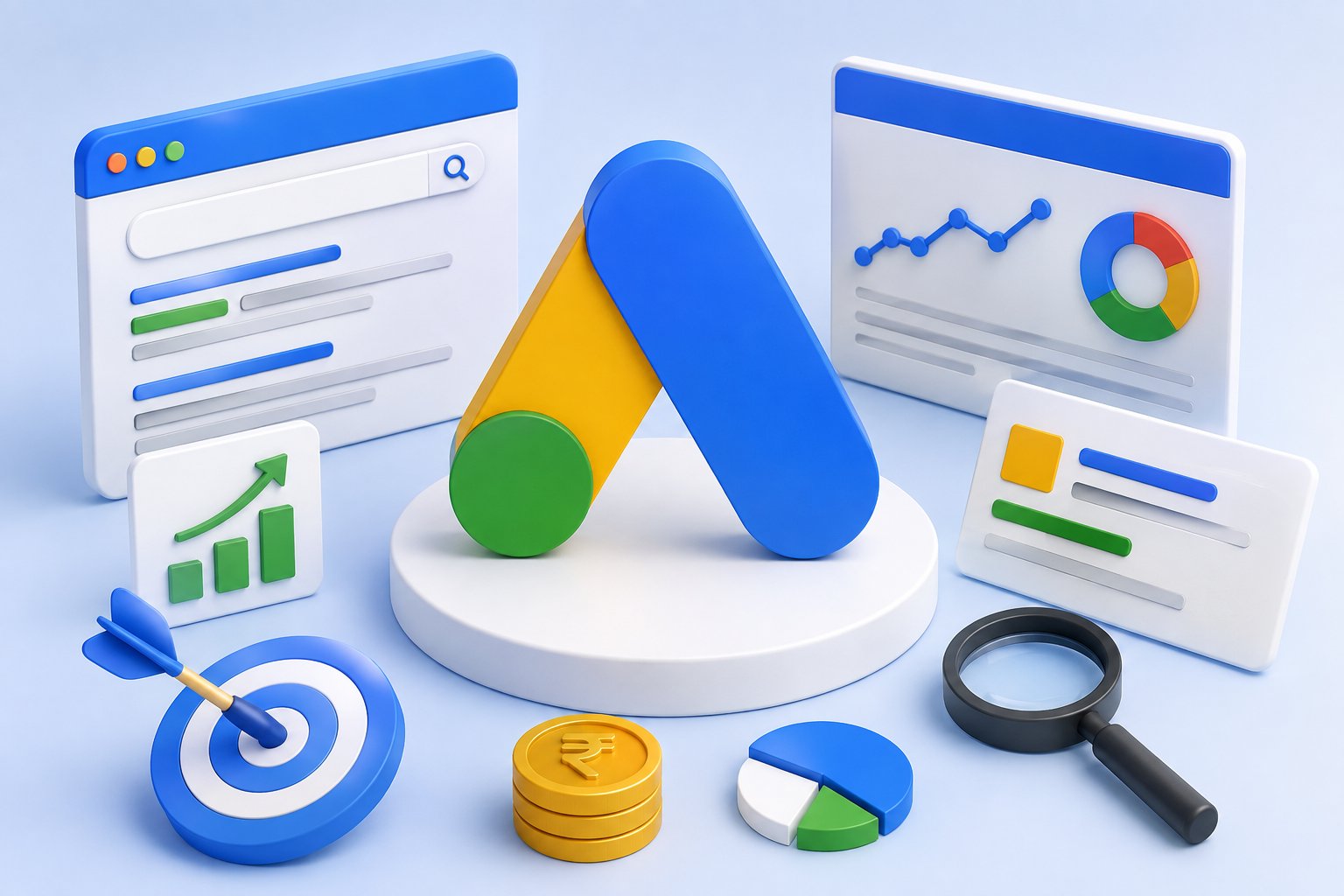
Google Ads Strategies for Business Growth in 2026
Google Ads continues to be an important digital marketing channel for businesses that want to reach potential customers quickly and generate targeted traffic. Unlike organic marketing methods that can take time to build visibility, paid search advertising can place a business in front of people who are actively searching for relevant products or services.
In 2026, successful Google Ads campaigns require more than simply selecting keywords and creating advertisements. Businesses need a strategic approach that combines keyword targeting, compelling ad copy, conversion tracking, audience targeting, landing-page optimization, bidding strategies and continuous campaign analysis.
What Are Google Ads?
Google Ads is Google's online advertising platform that allows businesses to promote their products and services across Google's search and advertising network.
When a potential customer searches for a product or service, relevant advertisements can appear alongside organic search results. Businesses generally pay when users interact with their advertisements, depending on the campaign and bidding model.
For example, a business offering digital marketing services in Pondicherry could target searches such as:
- Digital marketing company in Pondicherry
- SEO company in Pondicherry
- Google Ads company in Pondicherry
- Social media marketing agency in Pondicherry
- Digital marketing services near me
This allows businesses to target users who already have an interest in their products or services.
Why Google Ads Is Important for Business Growth
One of the biggest advantages of Google Ads is its ability to connect businesses with users who have a specific search intent.
Someone searching for “best Google Ads company in Pondicherry†is likely to have a different intent from someone casually reading an article about online advertising.
With the right campaign strategy, businesses can use this intent to reach potential customers at important stages of their buying journey.
Google Ads can help businesses:
- Generate targeted website traffic
- Reach high-intent customers
- Generate leads
- Promote specific services
- Increase brand visibility
- Support new product launches
- Target specific locations
- Measure advertising performance
1. Start With Clear Campaign Goals
Before creating a Google Ads campaign, businesses should determine what they want to achieve.
Common goals include:
- Lead generation
- Website traffic
- Online sales
- Phone calls
- Brand awareness
- App installations
- Local business enquiries
A campaign designed to generate leads will require a different strategy from a campaign designed primarily to increase brand awareness.
Having a clear goal also makes it easier to measure campaign performance.
2. Choose the Right Keywords
Keyword selection is one of the most important parts of a search advertising campaign.
Businesses should identify keywords that are closely connected to their products or services and understand the intent behind each search.
For example, a digital marketing company might target:
Informational keywords
- What is digital marketing?
- How does SEO work?
Commercial keywords
- Best SEO company
- Digital marketing services
High-intent keywords
- Hire SEO company
- Google Ads company in Pondicherry
- Digital marketing agency near me
Understanding search intent helps businesses avoid spending their advertising budget on searches that are unlikely to generate customers.
3. Create Relevant Ad Copy
Getting an advertisement in front of a potential customer is only the first step.
The advertisement also needs to communicate why the user should click.
Effective ad copy should clearly communicate:
- The service or product
- The primary benefit
- A relevant location
- A strong value proposition
- A clear call to action
For example, instead of a generic advertisement saying:
Digital Marketing Services
a more specific advertisement could communicate:
Digital Marketing Company in Pondicherry
SEO, Google Ads & Social Media Marketing
Grow Your Online Presence Today
Relevant messaging can make the advertisement more closely aligned with the user's search.
4. Optimize Landing Pages
A Google Ads campaign does not end when someone clicks the advertisement.
The landing page plays an important role in converting that visitor into a lead or customer.
A good landing page should have:
- Clear messaging
- Relevant information
- Fast loading speed
- Mobile-friendly design
- Strong call-to-action buttons
- Simple enquiry forms
- Trust signals
- Relevant service information
If an advertisement promotes Google Ads services but sends users to an unrelated page, visitors may leave without taking action.
The landing page should therefore match the advertisement and the user's search intent.
5. Use Conversion Tracking
One of the biggest advantages of digital advertising is the ability to measure results.
Businesses should track meaningful actions such as:
- Form submissions
- Phone calls
- WhatsApp enquiries
- Purchases
- Sign-ups
- Downloads
- Bookings
Traffic alone does not necessarily indicate campaign success.
For example, a campaign generating 5,000 visitors but no enquiries may be less valuable than a campaign generating 500 visitors and 50 qualified leads.
Conversion tracking helps businesses understand which campaigns, keywords and advertisements are actually contributing to business growth.
6. Use Smart Bidding Strategically
Modern Google Ads campaigns can use automated bidding strategies that optimize bids based on campaign objectives and available conversion data.
Businesses can choose bidding approaches according to their goals, such as maximizing conversions, conversion value or other campaign objectives.
However, automation works best when campaigns have accurate conversion tracking, relevant targeting and sufficient data.
Automation should therefore be combined with regular campaign monitoring rather than treated as a complete replacement for campaign management.
7. Focus on Local Google Ads
Local advertising can be particularly valuable for businesses serving a specific geographic area.
A business in Pondicherry, for example, may want to focus its advertisements on customers searching for services in Pondicherry and nearby areas.
Location-focused campaigns can help reduce wasted advertising spend by focusing on audiences that are more likely to become customers.
Local businesses can target searches related to:
- Service + location
- Product + location
- Company + location
- Near-me searches
This can make Google Ads more relevant to local customers.
8. Optimize for Mobile Users
A large portion of online searches happen through mobile devices.
Businesses should therefore make sure that both their advertisements and landing pages provide a good mobile experience.
Important considerations include:
- Fast loading pages
- Readable text
- Easy navigation
- Mobile-friendly forms
- Click-to-call buttons
- WhatsApp options
- Clear calls to action
A great advertisement can still lose potential customers if the landing page is difficult to use on a smartphone.
9. Test Different Advertisements
Testing is an important part of Google Ads optimization.
Businesses can experiment with different:
- Headlines
- Descriptions
- Calls to action
- Offers
- Landing pages
- Keyword groups
- Audience segments
Instead of assuming which advertisement will perform best, advertisers can use actual campaign data to identify stronger combinations.
Continuous testing can help improve campaign performance over time.
10. Monitor Negative Keywords
Not every search related to a keyword is valuable to a business.
Negative keywords can help prevent advertisements from appearing for irrelevant searches.
For example, a company offering professional Google Ads management may not want to appear for searches related to:
- Free Google Ads courses
- Google Ads jobs
- Google Ads tutorials
- Google Ads certification
Adding appropriate negative keywords can help reduce irrelevant clicks and improve the quality of traffic.
11. Combine Google Ads With SEO
Google Ads and SEO should not necessarily be treated as competing strategies.
They can work together as part of a broader digital marketing strategy.
SEO can help businesses build long-term organic visibility.
Google Ads can provide paid visibility for targeted searches.
For example, a business can use Google Ads to immediately promote a service while simultaneously developing SEO content to build organic rankings over time.
Combining both strategies can create a stronger overall search marketing approach.
12. Use Google Ads Data to Improve SEO
Paid advertising can also provide useful insights for organic marketing.
Businesses can analyze which search terms, advertisements and landing pages generate strong engagement or conversions.
These insights can help identify topics and keywords that may also be valuable for SEO content.
For example, if a particular Google Ads keyword consistently generates qualified leads, the business could consider developing an SEO-focused service page or blog around that topic.
13. Focus on Quality Leads, Not Just Clicks
A common mistake in digital advertising is focusing only on clicks.
A campaign with a large number of clicks is not necessarily successful if those visitors do not become customers.
Businesses should consider:
- Cost per lead
- Lead quality
- Conversion rate
- Customer acquisition cost
- Revenue generated
- Return on advertising spend
The ultimate goal should be business growth, rather than simply increasing website traffic.
Google Ads for Small Businesses
Small businesses can benefit from Google Ads when campaigns are carefully targeted.
Instead of competing for extremely broad keywords, smaller businesses can focus on specific services, locations and customer needs.
For example, a local business could target:
Service + Pondicherry
or
Product + Pondicherry
This can help create a more focused advertising strategy and make better use of a limited advertising budget.
Google Ads and Digital Marketing
Google Ads is only one component of a complete digital marketing strategy.
Businesses can combine paid advertising with:
- SEO
- AEO
- GEO
- Social media marketing
- Content marketing
- Website development
- Branding
- Google Business Profile optimization
Each channel can support a different stage of the customer journey.
For example:
Google Ads → Landing Page → Enquiry → Follow-up → Customer
At the same time:
SEO → Blog → Organic Traffic → Website → Lead
Combining these channels can create a more complete digital marketing ecosystem.
Benefits of Professional Google Ads Management
Managing Google Ads effectively requires continuous monitoring and optimization.
Professional campaign management can help businesses with:
- Keyword research
- Campaign structure
- Ad creation
- Audience targeting
- Location targeting
- Conversion tracking
- Budget management
- Negative keyword optimization
- Landing-page recommendations
- Performance analysis
- Campaign testing
A structured approach can help businesses make better use of their advertising budget.
Google Ads Strategies for Businesses in Pondicherry
For businesses targeting customers in Pondicherry, local search intent can be particularly valuable.
Campaigns can focus on relevant combinations such as:
- Google Ads company in Pondicherry
- Digital marketing company in Pondicherry
- SEO services in Pondicherry
- Website development company in Pondicherry
- Social media marketing in Pondicherry
The most effective keywords will depend on the business, target audience, competition and campaign objective.
Conclusion
Google Ads remains a powerful digital marketing tool for businesses in 2026, but successful advertising requires more than simply running campaigns.
Businesses need to understand their audience, choose relevant keywords, create compelling advertisements, optimize landing pages, track conversions and continuously analyze performance.
Combining Google Ads with SEO, AEO, GEO, content marketing, social media and a strong website can create a more complete digital marketing strategy.