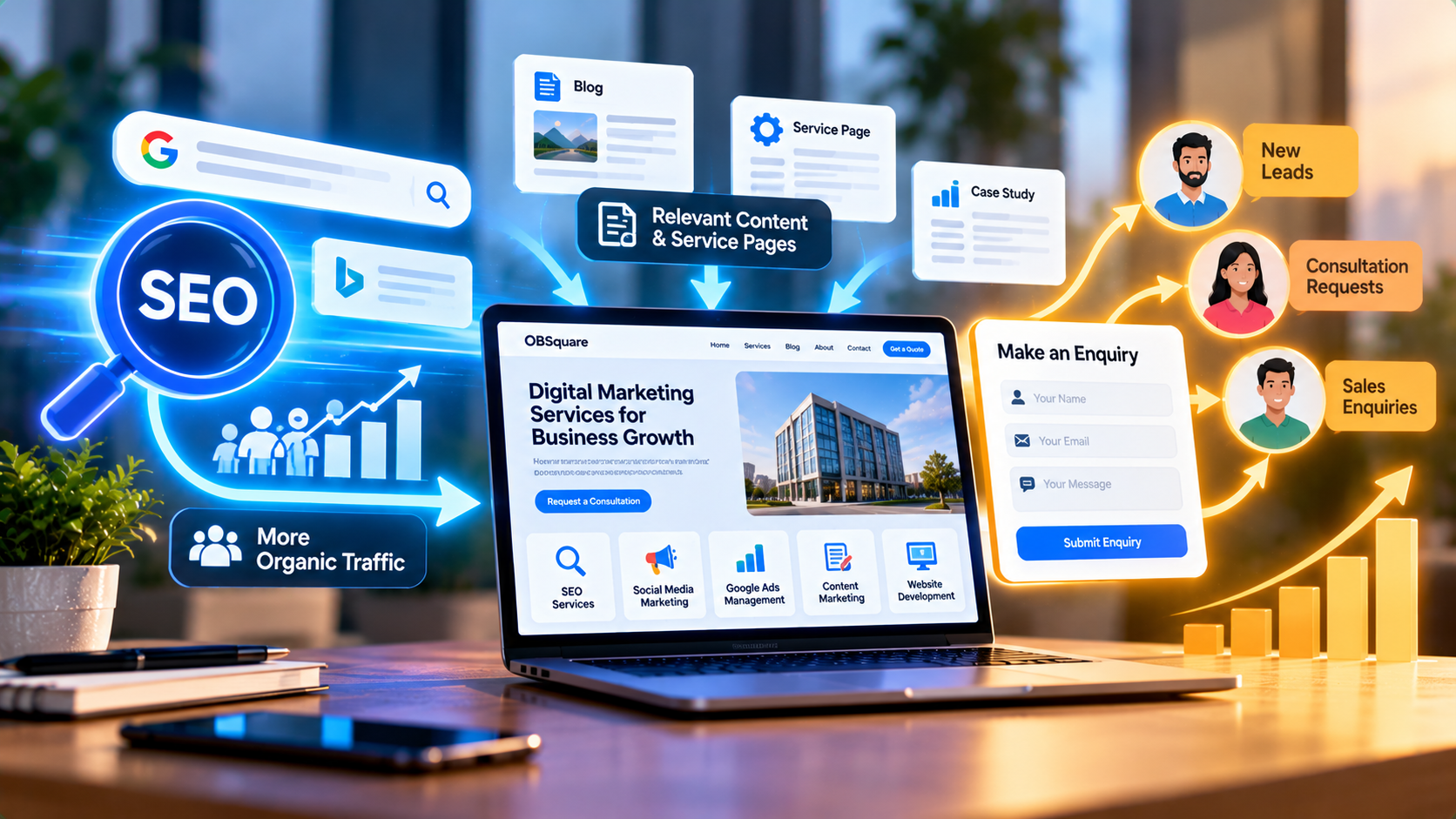
How Can Businesses Turn SEO Traffic Into Consistent Sales Enquiries?
Introduction: Why Is SEO Traffic Not Always Enough?
Many businesses invest in Search Engine Optimization (SEO) to improve website visibility and attract more visitors. However, an increase in organic traffic does not automatically lead to more enquiries or sales.
A website might attract hundreds of visitors without generating a single qualified lead if its content does not match their needs, its services are unclear, or its enquiry process is difficult to use.
Successful digital marketing requires businesses to consider what happens after a visitor arrives. Can visitors understand the services offered? Can they find answers to their questions? Is there a clear next step when they are ready to make an enquiry?
These questions connect SEO with conversion optimization and lead generation.
At OBSquare, an effective digital marketing strategy should focus not only on attracting relevant visitors but also on creating a clear path from search discovery to meaningful customer action.
What Is the Difference Between SEO Traffic and Qualified Leads?
SEO traffic refers to visitors who arrive at a website through organic search results. Qualified leads are potential customers whose needs, interests, or requirements align with the business's offerings.
A website can receive substantial traffic from people who are researching a topic but have no intention of purchasing a service. Conversely, a smaller number of highly relevant visitors may generate valuable enquiries.
For example, a digital marketing agency may attract visitors searching for the definition of SEO. Some may be students conducting research, while others may be business owners looking for professional SEO services.
Both audiences can benefit from educational content, but they have different commercial intentions.
The objective is to attract relevant visitors and help those who need the service move toward an appropriate next step.
How Can Search Intent Help Businesses Generate More Enquiries?
Search intent describes the reason behind a person's search query. Understanding intent helps businesses create pages that match what potential customers want to find.
1. Target Commercially Relevant Keywords
Businesses should identify keywords that indicate interest in their products or services.
For example, searches related to a service provider, service pricing, professional assistance, or comparisons between providers may indicate that the user is evaluating available options.
These keywords can guide service pages, comparison articles, and other content intended for people who are considering a purchase.
2. Match Content to the Search Query
A page should deliver what its title and search snippet promise.
If someone searches for SEO services for a small business, a generic article explaining what SEO means may not satisfy the user's intent. A dedicated service page explaining the offering, process, scope, and enquiry options is likely to be more appropriate.
Matching search intent helps visitors find relevant information and understand whether the business can meet their needs.
3. Create Content for Different Buying Stages
Not every visitor is ready to contact a business immediately.
Some visitors need introductory information, while others are comparing providers or looking for a specific service. Businesses should develop content for these different stages and connect related pages through useful internal links.
This allows visitors to move from learning about a problem to evaluating possible solutions without being pushed into an enquiry too early.
How Can Service Pages Convert Organic Visitors Into Leads?
Service pages are important because they explain what a business offers and help visitors decide whether the service is suitable for them.
A page that attracts search traffic but does not explain the offering clearly may struggle to generate enquiries.
Explain the Service Clearly
Start by explaining what the service includes, who it is designed for, and what problems it addresses.
For example, a digital marketing agency offering SEO services should describe relevant activities such as keyword research, on-page optimization, content planning, technical SEO, and performance monitoring, where these are genuinely part of the service.
Clear descriptions help visitors evaluate the offering without having to guess what they will receive.
Communicate Practical Benefits
Businesses should explain how their services can address customer needs rather than relying on broad promotional claims.
A website development service page might explain how a well-designed website can improve usability, present business information clearly, and provide convenient enquiry options.
Avoid promising guaranteed rankings, sales, or lead volumes. Outcomes depend on multiple factors, and transparent communication helps build trust.
Include Relevant Evidence
When available, businesses can strengthen service pages with genuine testimonials, case studies, project examples, and verifiable results.
Evidence should be authentic and presented with enough context for visitors to understand what was achieved.
Provide a Clear Next Step
Visitors should know how to proceed if they are interested.
Depending on the service, an appropriate next step may be requesting a consultation, submitting an enquiry, calling the business, or reviewing a relevant case study.
The call to action should be easy to find and relevant to the page's purpose.
How Can Calls to Action Improve SEO Lead Generation?
A call to action (CTA) encourages visitors to take a specific next step. It connects the information on a webpage with the action the business wants the visitor to consider.
Use Specific and Relevant CTA Messages
Generic messages may not communicate what happens after a visitor clicks.
A more descriptive CTA can explain the next step, such as requesting a consultation or asking for service information.
The wording should match the actual service and the action available on the page.
Place CTAs Where They Help the Reader
Visitors may be ready to act at different points in an article or service page. A CTA can appear after a useful explanation, near a relevant service description, or at the end of a page.
However, adding too many competing CTAs can distract visitors. Each page should have a clear primary action, supported by secondary options where appropriate.
Match the CTA to the Visitor's Intent
Someone reading an introductory blog may prefer to explore a related guide. A visitor on a detailed service page may be more likely to request a consultation.
Offering an appropriate next step can make the customer journey more natural and useful.
How Can Website User Experience Affect Lead Generation?
Even when SEO attracts the right audience, a poor website experience can prevent visitors from making an enquiry.
Improve Mobile Usability
Many visitors browse websites on mobile devices. Pages should display correctly on smaller screens, text should be readable, and buttons and form fields should be easy to use.
Businesses should test important landing pages on different screen sizes rather than assuming that a desktop design will work equally well on mobile.
Improve Page Speed
Slow pages can frustrate visitors and interrupt the customer journey.
Optimizing images, reducing unnecessary scripts, improving caching, and reviewing hosting performance can help create a smoother experience.
Performance improvements should be evaluated alongside other user experience factors, since speed alone does not guarantee more conversions.
Make Navigation Clear
Visitors should be able to find service details, contact information, pricing information where applicable, and relevant supporting content without unnecessary effort.
Clear navigation reduces confusion and helps users explore the website according to their needs.
Remove Unnecessary Form Fields
Long enquiry forms may discourage potential customers from completing them.
Businesses should request only the information needed to respond effectively. For example, a basic service enquiry might require a name, contact method, service interest, and a short message.
The appropriate fields depend on the business and the purpose of the enquiry.
How Can Content Marketing Support SEO Traffic Conversion?
Content marketing can help businesses answer customer questions, explain their expertise, and guide readers toward relevant services.
Create Helpful Educational Blogs
Educational articles can attract visitors who are researching a problem or trying to understand their options.
For example, a business offering social media marketing services could publish a guide explaining how businesses can choose suitable social media channels. The article could link naturally to a service page for readers who want professional support.
The purpose is to help readers first and introduce a relevant service when it genuinely fits their needs.
Use Case Studies to Support Decision-Making
Case studies can show how a business approaches a problem and delivers a service.
Where genuine project information is available, a case study can explain the customer's challenge, the work performed, and the results achieved. Businesses should avoid presenting isolated outcomes as guaranteed results for every customer.
Connect Related Articles and Service Pages
Internal links help readers explore relevant information.
A blog about local SEO can link to a local SEO service page, while a broader digital marketing guide can link to articles about content marketing, advertising, and lead generation.
These connections make it easier for interested visitors to discover the services that relate to their needs.
How Can AEO Help Businesses Convert Search Visitors?
Answer Engine Optimization (AEO) focuses on making content useful for answer-oriented search experiences by addressing customer questions clearly.
AEO can complement lead generation by helping businesses provide the information visitors need before contacting a service provider.
Answer Common Questions About Your Services
Businesses should identify questions about pricing, process, timelines, service inclusions, and expected outcomes.
For example, an SEO agency could explain which factors influence the time needed to improve organic search performance. An advertising agency could explain how campaign budgets, audience targeting, and landing pages affect campaign results.
Accurate answers help visitors understand the service and make more informed decisions.
Build Useful FAQ Sections
Frequently asked questions can address common concerns that might otherwise prevent a potential customer from proceeding.
Questions should be relevant to the page and answered accurately. FAQ content should not be added merely to insert keywords or create unnecessary page length.
Connect Answers to Relevant Actions
After answering a customer's question, the page can provide an appropriate next step, such as reviewing the service details or submitting an enquiry.
AEO does not guarantee featured answers or AI visibility, but clear and useful information can support a better experience for prospective customers.
How Can GEO Support Trust and Lead Generation?
Generative Engine Optimization (GEO) focuses on making content and brand information understandable and potentially useful to generative AI-powered search experiences.
GEO can complement lead generation by encouraging businesses to communicate their services, expertise, and business identity clearly.
Maintain Consistent Business Information
Businesses should ensure that their name, services, website, contact details, and other important information are accurate across relevant online platforms.
Consistent information helps potential customers understand who the business is and what it offers.
Publish Credible and Useful Content
Businesses should demonstrate their knowledge through helpful articles, genuine case studies, accurate service descriptions, and transparent explanations.
Content should prioritize real audience needs rather than generic claims about being the best provider.
Measure Business Outcomes
Where analytics data is available, businesses can examine whether identifiable referral visits from AI-powered platforms lead to relevant engagement or enquiries.
AI visibility and attribution can be difficult to measure completely, so GEO should be evaluated alongside established SEO, content marketing, and conversion metrics.
No GEO strategy guarantees that a business will be recommended by an AI platform.
How Can Businesses Measure SEO Lead Generation Performance?
Businesses should evaluate SEO using metrics that connect search visibility with meaningful customer actions.
Organic Traffic and Search Performance
Google Search Console can help track search impressions, clicks, queries, and page performance. Analytics tools can help businesses understand which landing pages attract visitors and how they interact with the website.
Enquiry and Conversion Tracking
Businesses should track important actions such as completed enquiry forms, calls, appointment requests, and purchases where applicable.
Conversion tracking should be implemented carefully to avoid duplicate or inaccurate counts.
Qualified Leads
Not all enquiries are equally valuable. Businesses should define what makes a lead qualified, based on criteria such as service relevance, customer requirements, location, budget, or readiness to proceed.
This helps marketing teams understand whether organic traffic is attracting the right audience.
Lead-to-Customer Conversion Rate
Businesses can also evaluate how many qualified leads become paying customers. This provides additional context about the quality of enquiries and the effectiveness of the sales process.
Performance should be reviewed over time, since SEO results and customer decisions may take time to develop.
Common Mistakes That Prevent SEO Traffic From Generating Leads
Businesses may struggle to convert organic visitors when they focus only on rankings or traffic.
Attracting irrelevant traffic: Keywords should relate to the services and audiences the business wants to reach.
Using vague service descriptions: Visitors need to understand what the business offers and how the service addresses their needs.
Hiding contact options: Enquiry options should be visible and easy to access.
Using complicated forms: Unnecessary fields can create friction and discourage submissions.
Making unsupported promises: Guaranteed rankings or sales claims can undermine credibility.
Ignoring mobile usability: A difficult mobile experience can prevent interested visitors from completing an enquiry.
Failing to measure conversions: Without appropriate tracking, businesses cannot reliably evaluate which pages contribute to leads.
Addressing these issues can improve the connection between SEO activity and business outcomes.
How Can OBSquare Help Businesses Turn SEO Traffic Into Enquiries?
OBSquare supports businesses with digital marketing services designed to strengthen online visibility and connect marketing activities with business goals.
Depending on a business's needs, a coordinated strategy may include SEO, keyword research, content marketing, blog writing, website content optimization, Google Business Profile management, social media marketing, paid advertising, and website development.
For SEO lead generation, businesses can focus on attracting relevant visitors, improving service-page clarity, publishing useful content, simplifying enquiry processes, and measuring qualified leads.
OBSquare can help businesses plan and coordinate these activities according to their target audience, services, competition, and budget.
The objective is to move beyond measuring website traffic alone and focus on creating useful digital experiences that help potential customers understand the business and take an appropriate next step.
Conclusion: Turn Organic Search Visibility Into Business Opportunities
SEO can help businesses reach people who are searching for relevant information, products, and services. However, generating meaningful enquiries requires more than attracting visitors.
Businesses need to understand search intent, create relevant landing pages, explain their services clearly, build trust, and make the enquiry process convenient.
Content marketing can educate potential customers, AEO can support clear answers to common questions, and GEO can complement efforts to communicate credible brand information across evolving search experiences.
By combining these activities with conversion tracking and ongoing improvement, businesses can work toward a stronger relationship between organic search visibility and lead generation.
OBSquare can help businesses develop an integrated digital marketing strategy focused on attracting relevant audiences, building customer confidence, and generating meaningful sales opportunities.