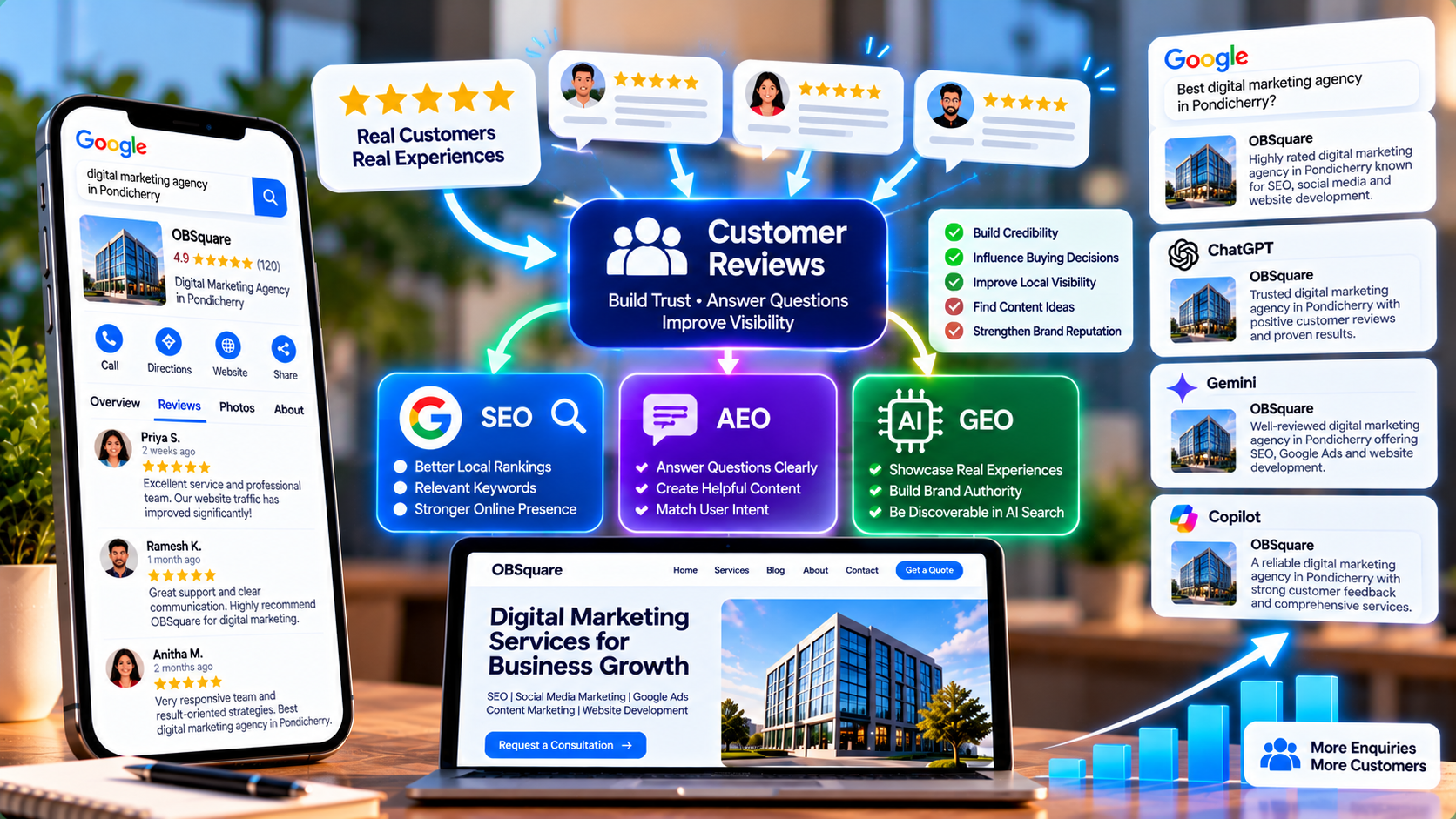
How Can Businesses Use Customer Reviews to Strengthen SEO, AEO, and GEO Strategies?
Introduction: Why Customer Reviews Matter in Digital Marketing
When customers search for a product, service, or local business, they often look beyond advertisements and website content. They want to understand other customers’ experiences before making a decision. This makes online reviews an important part of a business’s digital marketing strategy.
Customer reviews can communicate service quality, highlight common customer concerns, and help potential buyers evaluate a business. They can also provide useful information for improving website content, local search optimization, and customer communication.
By integrating customer feedback into SEO, Answer Engine Optimization (AEO), and Generative Engine Optimization (GEO), businesses can build a more credible online presence and make it easier for customers to discover relevant information.
1. How Customer Reviews Support SEO
Search Engine Optimization (SEO) helps businesses improve the visibility of their websites in search engine results. Customer reviews can contribute to this broader strategy, particularly for local businesses.
Reviews on platforms such as Google Business Profile can help potential customers understand what a business offers and what previous customers experienced. Review content may also contain natural descriptions of services, locations, and customer needs.
Businesses can strengthen their SEO strategy by:
- Maintaining an accurate and complete Google Business Profile.
- Encouraging genuine customers to share honest feedback.
- Responding professionally to positive and negative reviews.
- Monitoring recurring customer questions and service-related terms.
- Using customer feedback to improve relevant website pages.
Reviews should not be treated as a guaranteed way to achieve higher rankings. Search engines consider multiple factors, and review quantity alone does not determine search performance.
2. How Customer Reviews Support AEO
Answer Engine Optimization (AEO) focuses on making information clear, useful, and easy for answer-oriented search experiences to interpret.
Customers frequently ask questions before contacting a business, such as:
- Is this service suitable for small businesses?
- What do customers say about the quality of the service?
- How quickly does the business respond to enquiries?
- What should I expect before purchasing this service?
Customer reviews can reveal the questions and concerns people have when evaluating a business. Marketing teams can use these insights to create informative FAQ sections, service explanations, comparison guides, and helpful blog articles.
For example, if customers repeatedly ask about installation time, a business could publish a clear guide explaining the process, expected timelines, and factors that may affect completion.
This approach helps answer real customer questions instead of creating content based only on assumptions.
3. How Customer Reviews Can Contribute to GEO
Generative Engine Optimization (GEO) focuses on making a brand’s information useful, clear, credible, and easy to understand across AI-powered discovery experiences.
Reviews can provide additional context about customer experiences, frequently discussed services, and common business strengths. However, the presence of positive reviews does not guarantee that an AI system will mention or recommend a particular brand.
Businesses can strengthen the foundations of their GEO strategy by:
- Maintaining consistent business information across important online platforms.
- Publishing detailed, accurate service descriptions on their websites.
- Sharing genuine customer testimonials with appropriate permission.
- Answering common questions using clear and factual content.
- Keeping business details, service areas, and contact information up to date.
- Monitoring how their brand appears in relevant search experiences.
A consistent digital presence helps customers understand the business and gives search systems clearer information to work with.
4. How to Collect Genuine Customer Reviews
An effective review strategy begins with delivering a good customer experience. Businesses should invite feedback without pressuring customers to leave only positive reviews.
Practical ways to encourage genuine reviews include:
- Sending a polite review request after completing a service.
- Sharing a direct link to the business’s review page.
- Adding a QR code to invoices, packaging, or customer follow-up messages.
- Making the review process simple and convenient.
- Asking customers for feedback at an appropriate point in their journey.
Businesses should follow the review platform’s policies and applicable laws. They should not purchase fake reviews, create reviews from employees pretending to be customers, or offer incentives in ways prohibited by the platform.
Authentic feedback provides more useful insights and supports long-term customer trust.
5. Responding to Reviews to Build Customer Trust
Collecting reviews is only one part of the process. How a business responds can also influence how potential customers perceive its professionalism and commitment to service.
For positive reviews, thank customers and acknowledge the specific experience they described. Avoid copying the same generic response for every review.
For negative reviews, remain professional, acknowledge the concern, and offer an appropriate way to resolve the issue. Do not disclose private customer information or argue publicly.
A thoughtful response strategy demonstrates that the business takes customer feedback seriously. It can also reveal recurring service problems that need attention.
6. Turning Review Insights Into Better Website Content
Customer feedback can become a valuable source of content ideas.
For example, a digital marketing agency may receive feedback about communication, campaign reporting, website improvements, or lead-generation support. These themes can help the agency identify which aspects of its services need clearer explanations.
Businesses can use review insights to improve:
- Service pages that explain deliverables and processes.
- FAQ sections addressing recurring concerns.
- Blog articles that answer common customer questions.
- Case studies that describe real projects and outcomes.
- Landing pages that explain the value of a specific service.
Any published testimonial or case study should be genuine, accurately represented, and used with the appropriate permission. Businesses should never invent customer quotations, results, or endorsements.
7. Combining Reviews With Local SEO
Local businesses can benefit from managing customer reviews alongside their local SEO activities.
A complete local search strategy includes accurate business information, relevant service pages, an updated Google Business Profile, and a reliable process for collecting and responding to feedback.
For businesses serving a specific area, customer reviews may help prospective customers understand the services offered and the experiences of other local customers.
Businesses should also maintain consistent details such as their name, address, phone number, opening hours, and service areas wherever these details are published.
For a business operating in Pondicherry, for example, location-specific service pages and accurate business listings can help customers understand which areas the business serves. Reviews should support this information rather than replace useful local website content.
8. Measuring the Impact of Customer Reviews
Businesses should measure whether their review strategy is helping them build trust and improve customer acquisition rather than focusing only on the total number of reviews.
Useful metrics include:
- Review growth: Changes in the number of genuine reviews over time.
- Review quality: Common themes, detailed feedback, and recurring concerns.
- Response rate: How consistently the business responds to customer feedback.
- Local discovery: Relevant business profile visibility and customer interactions.
- Website engagement: Visits to service pages, FAQ pages, and testimonial sections.
- Enquiry generation: Calls, form submissions, and other qualified leads.
- Customer conversion: The proportion of enquiries that become customers.
Businesses can use analytics, website enquiry tracking, and business profile performance data to understand which activities contribute to meaningful results. Changes in traffic or enquiries should be assessed alongside other marketing activities rather than attributed to reviews alone.
9. Common Customer Review Mistakes to Avoid
Even businesses with good services can weaken their online reputation through poor review management.
Common mistakes include:
- Buying fake reviews or publishing misleading testimonials.
- Asking only satisfied customers to leave reviews.
- Ignoring negative feedback or responding aggressively.
- Using identical responses for every customer.
- Publishing testimonials without suitable permission.
- Treating reviews as a substitute for SEO and helpful website content.
- Assuming positive reviews guarantee AI search visibility.
- Failing to investigate repeated customer complaints.
A sustainable strategy focuses on genuine feedback, responsible responses, and continuous improvement.
10. How OBSquare Can Help Businesses Strengthen Their Digital Presence
OBSquare, a product of Seyfert Infotech, helps businesses develop a more coordinated digital marketing strategy through services such as SEO, AEO, GEO, blog writing, Google Business Profile management, social media management, and website development.
These services can work together to help businesses maintain accurate online information, publish helpful content, improve their website experience, and communicate more effectively with potential customers.
A review strategy can support this work by identifying customer concerns, strengthening testimonial content, and highlighting areas where business communication or service delivery can improve.
The objective is not simply to collect more reviews. It is to build a credible digital presence that helps customers find accurate information, evaluate services, and make informed decisions.
Conclusion
Customer reviews are more than feedback about a product or service. When managed responsibly, they can help businesses understand customer expectations, improve local discovery, identify content opportunities, and strengthen trust across digital channels.
By combining genuine reviews with SEO, AEO, GEO, helpful website content, and consistent business information, businesses can build a stronger foundation for long-term online visibility and customer acquisition.
Start by collecting authentic feedback, responding thoughtfully, and using customer questions to improve your content. Over time, these practices can help create a more useful and trustworthy digital experience for prospective customers.
Build a stronger digital presence with OBSquare. Explore how coordinated SEO, AEO, GEO, content marketing, and Google Business Profile management can support your business’s online growth.