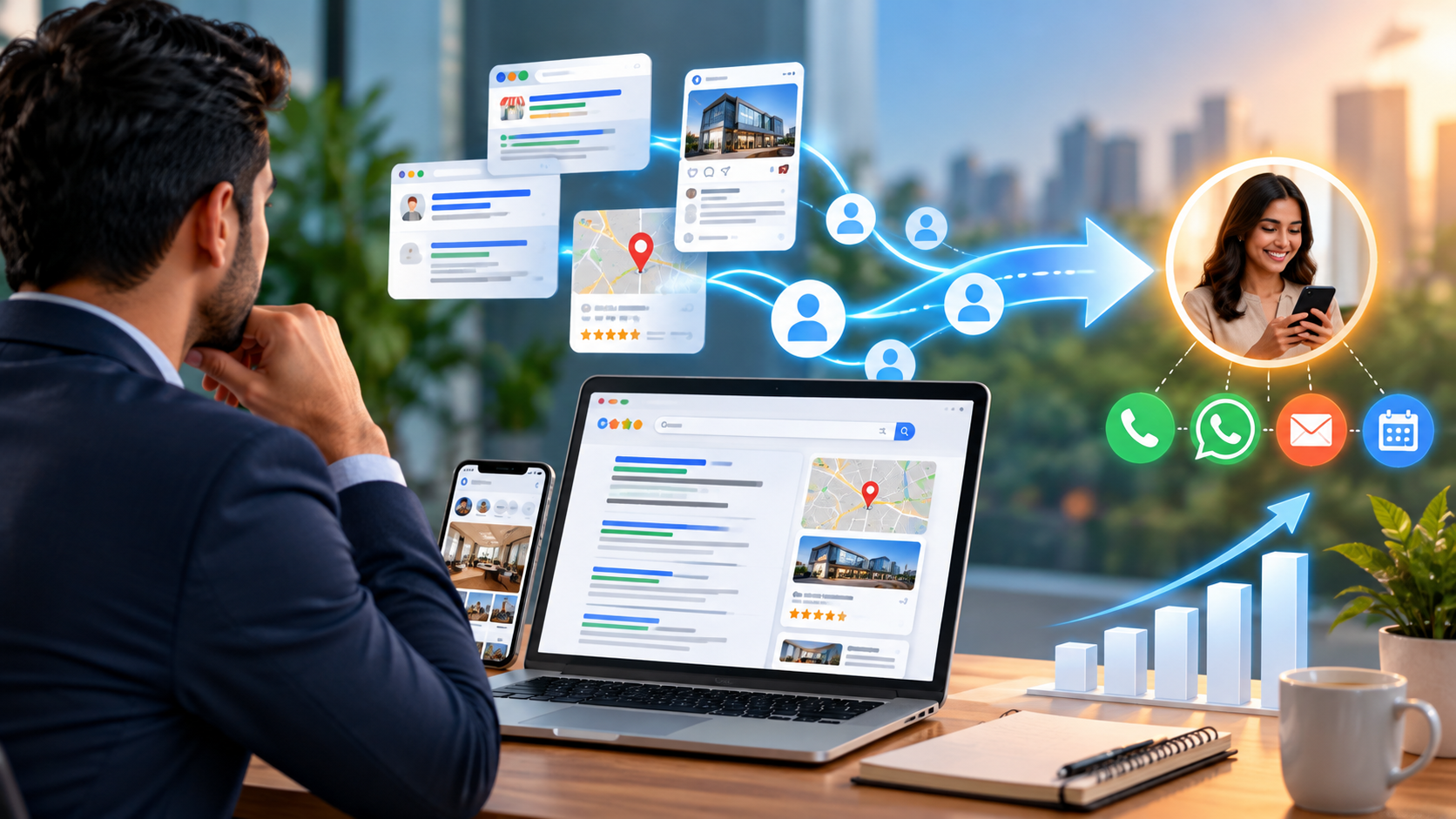
Why Is My Business Visible Online but Still Not Getting Customers?
Why Is My Business Visible Online but Still Not Getting Customers?
Having a website, social media profiles, and a Google presence does not automatically bring customers. Many businesses invest in digital marketing, receive website visitors or social media views, and still wonder why those visitors are not becoming enquiries or customers.
The problem is often not visibility alone. Customers need to find the right information, trust the business, understand the value of its products or services, and have an easy way to take the next step.
A successful digital marketing strategy connects visibility with customer intent and conversion.
Being Visible Online Is Only the First Step
When someone searches for a product or service, your business may appear in search results, Google Maps, social media, or other online platforms. However, appearing online does not guarantee that the person will contact you.
Customers may leave because they cannot quickly understand what your business offers, the website is difficult to use, the information is outdated, or there is not enough trust-building content.
Digital marketing should therefore focus not only on getting attention but also on creating a clear path from search → visit → trust → enquiry → customer.
Are You Reaching the Right Customers?
One common reason for poor results is reaching people who are not actually looking for your products or services.
For example, a business may receive thousands of website visits from general searches but very few visitors who are ready to make a purchase.
Effective SEO services focus on relevant search intent. Instead of targeting traffic simply because a keyword has high search volume, businesses should create content around the questions, problems, products, services, and locations that matter to their target customers.
Does Your Website Give Customers a Reason to Contact You?
A customer may discover your business through Google but leave your website within seconds if the information is unclear.
Your website should make it easy for visitors to understand:
- What your business offers
- Who your services are for
- Why customers should consider your business
- What makes your service different
- How to contact you
- What action they should take next
Clear service pages, useful content, strong calls to action, fast loading times, and mobile-friendly design can all contribute to a better customer journey.
Local Visibility Can Make a Big Difference
For businesses serving a particular city or region, being visible to nearby customers is especially important.
A customer searching for a service may use terms such as “near me,” a city name, or a specific local area. Optimizing your online presence for these searches can help your business become more discoverable to people who are looking for services in your area.
This is where local SEO and GEO-focused digital marketing become valuable. Accurate business information, useful location-based content, customer reviews, and a well-maintained Google Business Profile can strengthen local online visibility.
Social Media Views Do Not Always Mean Customers
Getting likes, views, shares, and followers can help increase awareness, but engagement numbers alone do not tell the complete story.
A business should consider whether its social media content is attracting the right audience and encouraging meaningful actions.
Content can guide potential customers toward:
- Visiting the website
- Sending an enquiry
- Calling the business
- Sending a WhatsApp message
- Requesting a quotation
- Visiting the physical location
The objective should be to connect social media activity with actual business goals.
Are Your Ads Reaching People With Purchase Intent?
Paid advertising can generate traffic quickly, but the quality of that traffic matters.
For example, Google Ads can help businesses reach people actively searching for specific products or services, while Meta Ads can help businesses reach audiences based on interests, demographics, behavior, and other targeting options.
A successful campaign requires more than simply creating an advertisement. The audience, message, landing page, offer, budget, and follow-up process should work together.
Trust Can Influence the Customer Decision
Customers often research a business before making contact. They may look at reviews, social media profiles, website content, photos, case studies, and other information before deciding whether to enquire.
This makes online reputation management an important part of digital marketing.
Useful content and genuine customer reviews can help potential customers understand what they can expect from a business before they make contact.
What About AI Search?
Online search is also changing as people increasingly use AI-powered tools to find information and discover businesses.
Businesses can prepare by creating clear, useful, and well-structured content that directly answers customer questions.
This includes creating FAQ sections, service explanations, location-specific content, helpful guides, and content that clearly explains products and services.
This approach supports AEO (Answer Engine Optimization) and can also strengthen the overall quality of a business's online presence.
Digital Marketing Should Focus on the Complete Customer Journey
A strong digital marketing strategy should not treat SEO, social media, advertising, content, and websites as completely separate activities.
They should work together.
A potential customer might first discover a business through Google, read a blog, visit the website, check reviews, watch a social media video, and finally contact the business.
Each of these touchpoints can contribute to the final decision.
How Can a Business Improve Its Results?
If your business is getting visibility but not enough customers, start by reviewing the complete customer journey.
Check whether:
- Your business is reaching the right audience.
- Your website clearly explains your services.
- Your pages target relevant search intent.
- Your local business information is accurate.
- Your content answers real customer questions.
- Your advertisements reach relevant audiences.
- Your online reviews build trust.
- Your calls to action make contacting you easy.
- Your website works well on mobile devices.
- You are measuring enquiries and conversions, not just views.
Conclusion
Online visibility is valuable, but visibility alone is not the final goal. The real objective is to connect the right audience with the right information at the right stage of their customer journey.
A well-planned digital marketing strategy combines SEO, local SEO, GEO, AEO, content marketing, social media, online advertising, website optimization, and reputation building to create a stronger path from online discovery to customer enquiry.
At OBSquare, digital marketing can be approached as a complete customer-growth system rather than simply a collection of individual services. By understanding what your customers search for, creating useful content, improving your online visibility, and making it easier for visitors to take action, your business can build a stronger and more meaningful digital presence.