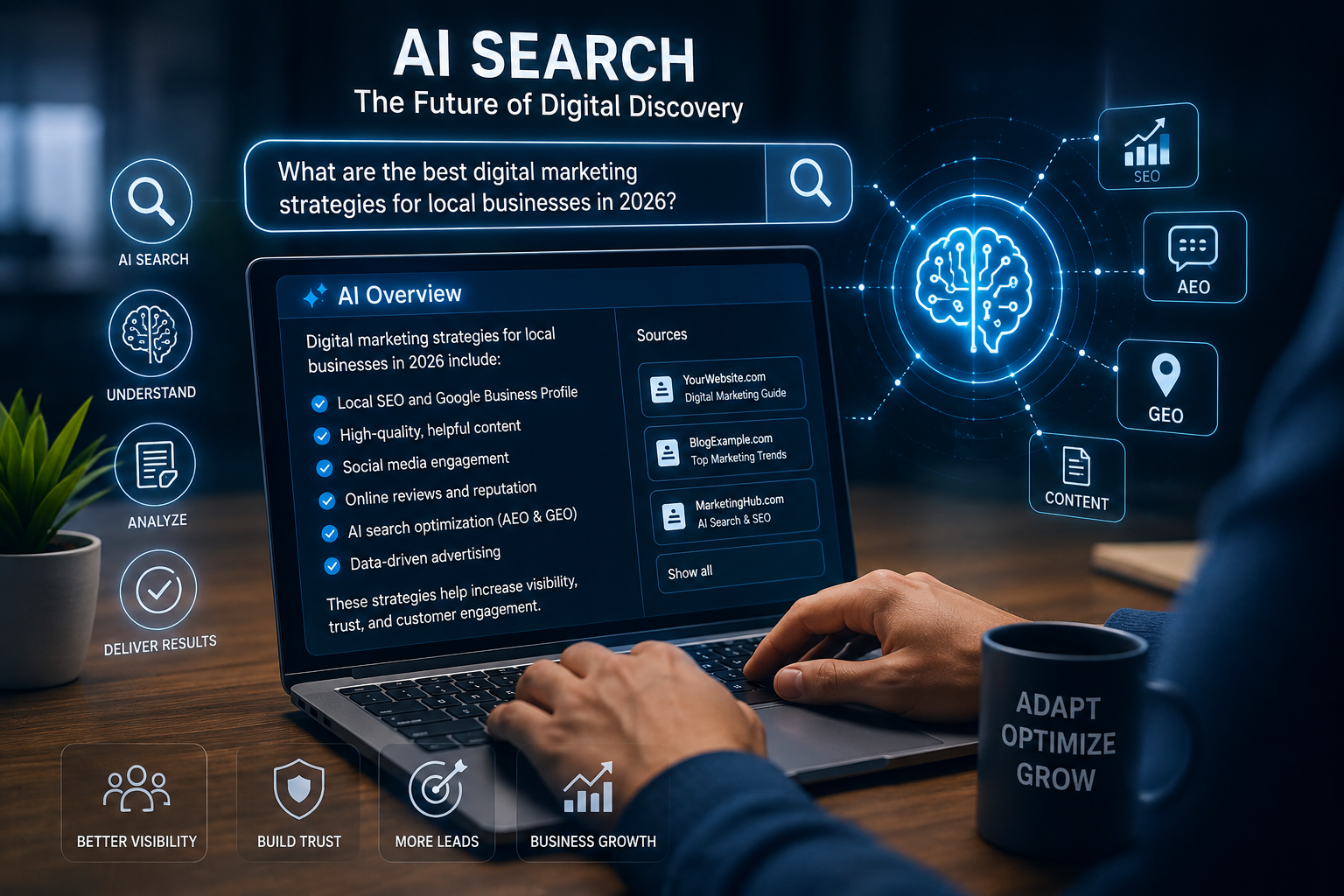
Why Businesses Need to Optimize for AI Search in 2026
Search is changing rapidly. Customers are no longer relying only on traditional keyword searches to find information, products, and services. They are increasingly asking longer, more conversational questions and using AI-powered search experiences to research, compare, and make decisions.
Google has expanded AI Overviews and AI Mode, while ChatGPT can search the web and provide answers with links to relevant sources. Google also reports that people are using AI-powered Search for more complex questions and that AI Mode has surpassed one billion monthly users.
For businesses, this creates a new digital marketing opportunity: being visible not only in traditional search results, but also in AI-generated answers and recommendations.
What Is AI Search?
AI search refers to search experiences that use artificial intelligence to understand a user's question, gather information, and generate a conversational response.
Traditional search generally works like this:
User Search → Search Results → Website → Information
AI-powered search can work more like:
User Question → AI Understanding → Multiple Sources → Generated Answer → Relevant Links
For example, instead of searching:
“digital marketing company Pondicherryâ€
a customer might ask:
“What should I look for when choosing a digital marketing company for my local business?â€
The search experience can understand the broader context of the question and provide a more detailed response.
Google's AI Mode is designed for longer and more complex queries, including follow-up questions, while ChatGPT Search can retrieve current information from the web and provide links to sources.
Why AI Search Matters for Businesses
Traditional SEO is still important, but the way customers discover information is expanding.
A business may now need to think about multiple discovery channels:
- Google Search
- Google AI Overviews
- Google AI Mode
- ChatGPT Search
- Social media
- Maps and local search
- Other AI-powered discovery platforms
This means businesses should create content that is useful not only for search engines but also for people and AI systems trying to understand their expertise.
What Is AI Search Optimization?
AI Search Optimization is the process of improving a business's online presence so that its information is easier for search systems and AI-powered experiences to understand, evaluate, and potentially surface.
It involves areas such as:
- High-quality content
- Clear website structure
- Relevant topic coverage
- Strong brand information
- Authoritative sources
- Local business information
- Structured data
- Helpful FAQs
- Consistent business details
- Original insights
- Strong online reputation
There is no guaranteed formula that makes a business appear in an AI-generated answer. Search systems use their own ranking and retrieval processes, and visibility cannot be guaranteed. OpenAI, for example, notes that ChatGPT search placement is not guaranteed and considers multiple factors when ranking results.
AI Search Is Changing How People Search
One of the biggest changes is the move from short keywords to longer questions.
Traditional search might be:
“SEO company Pondicherryâ€
A conversational search could be:
“Which SEO services are useful for a small business in Pondicherry?â€
This creates opportunities for businesses to answer the actual questions their customers have.
Instead of creating content only around individual keywords, businesses can build content around:
- Customer questions
- Problems
- Comparisons
- Solutions
- Industry topics
- Local requirements
- Buying decisions
Create Content That Answers Real Questions
One of the most important parts of preparing for AI search is creating genuinely useful content.
Businesses should ask:
What does my customer want to know?
For example, a digital marketing company could create content answering:
- How much does SEO cost?
- Is SEO useful for small businesses?
- What is the difference between SEO and AEO?
- How long does SEO take?
- How does local SEO work?
- What should a business post on Instagram?
- Is Google Ads better than SEO?
- How can a local business get more enquiries online?
These questions can become blog articles, FAQs, videos, guides, and social media content.
Build Topic Authority
Publishing one article about a subject may not be enough to demonstrate expertise.
Businesses can create a collection of related content around an important topic.
For example, instead of publishing only one article about SEO, a business could cover:
- SEO basics
- Local SEO
- Technical SEO
- Keyword research
- On-page SEO
- SEO content
- Link building
- SEO reporting
- SEO for small businesses
- Common SEO mistakes
This creates a broader information resource around the subject.
Focus on Helpful and Original Content
AI search does not make low-quality content more valuable.
Businesses should focus on providing information that is genuinely useful and original.
Good content can include:
- Original research
- Industry experience
- Real examples
- Case studies
- Expert opinions
- First-hand observations
- Data
- Practical recommendations
Google has specifically emphasized helping users discover original, high-quality content and firsthand perspectives within its AI search experiences.
Make Your Business Information Clear
AI systems need to understand what a business is, what it offers, and where it operates.
Businesses should maintain consistent information across their digital presence.
Important details include:
- Business name
- Services
- Location
- Contact information
- Website
- Business categories
- Areas served
- Industry
- Brand information
For a local company, clearly communicating its location and services can be particularly important.
For example:
Digital Marketing Company in Pondicherry
is much clearer than simply describing the company as a “digital solutions provider.â€
Local SEO Still Matters
AI search does not mean traditional local SEO is disappearing.
Businesses should continue optimizing their:
- Google Business Profile
- Website
- Local landing pages
- Reviews
- Business information
- Location-based content
Google's AI-powered Search continues to connect users with information from the web and local context, making accurate business information important for local discovery.
Use FAQs to Answer Customer Questions
Frequently asked questions can be an effective way to organize useful information.
A service page could answer questions such as:
What does your service include?
Who is the service suitable for?
How does the process work?
How long does it take?
What results can customers expect?
How can customers get started?
Clear answers make information easier for customers to understand and can also provide well-structured content for search systems to interpret.
Create Content Around Different Search Intents
Not every customer searches with the intention of immediately purchasing something.
Search intent can include:
Informational Intent
The customer wants to learn something.
Example:
“What is GEO in digital marketing?â€
Commercial Research
The customer is comparing options.
Example:
“SEO vs Google Ads for small businesses.â€
Transactional Intent
The customer is ready to take action.
Example:
“Best SEO company in Pondicherry.â€
Businesses should create content for each stage.
AI Search and AEO
AI search is closely connected with Answer Engine Optimization (AEO).
AEO focuses on creating content that clearly answers questions and provides useful information for answer-based search experiences.
Instead of focusing only on:
“Rank #1 for this keyword.â€
businesses can also think:
“Can my content provide the clearest answer to this question?â€
This shift encourages businesses to create more useful and structured information.
AI Search and GEO
Generative Engine Optimization (GEO) focuses on improving a brand's visibility within generative AI experiences.
The broader objective is to make a business easier for AI systems to understand when users ask questions related to its industry, products, services, or expertise.
GEO can involve:
- Strong topical content
- Brand mentions
- Relevant third-party references
- Structured information
- Original insights
- Consistent business information
- High-quality digital presence
However, businesses should avoid treating GEO as a guaranteed ranking formula. AI-generated answers can change depending on the query, sources, model, location, and other factors.
Build a Strong Digital Reputation
A business's website is only one part of its online presence.
AI search can use information from different sources, so businesses should build a consistent and credible digital footprint.
This can include:
- Website content
- Industry publications
- Business directories
- Customer reviews
- Social media
- News coverage
- Professional profiles
- Local business listings
A stronger overall digital presence can make it easier for customers—and potentially search systems—to understand the business.
Customer Reviews and AI Search
Reviews can contribute to a business's overall online reputation.
Businesses should encourage genuine customers to share honest experiences and respond professionally to feedback.
Reviews can communicate information about:
- Customer service
- Product quality
- Reliability
- Professionalism
- Local experience
Businesses should never manufacture reviews or manipulate customer feedback.
Use Multiple Content Formats
AI search optimization should not be limited to blog articles.
Businesses can create:
- Blogs
- Videos
- FAQs
- Guides
- Case studies
- Infographics
- Social media posts
- Podcasts
- Original research
Different formats allow businesses to communicate expertise in different ways.
Keep Content Updated
Digital information changes.
Services change. Prices change. Products change. Technology changes.
Businesses should regularly review important content to make sure it remains accurate.
For example, an article about digital marketing trends should not continue presenting outdated information years after publication.
Regular updates can improve the usefulness of the website for both customers and search systems.
Don't Forget Traditional SEO
AI search does not mean businesses should stop doing SEO.
Traditional SEO remains an important foundation.
Businesses should continue focusing on:
- Technical website health
- Search-friendly content
- Internal linking
- Relevant keywords
- Page experience
- Mobile usability
- Crawlability
- Website structure
- Quality backlinks
- Search intent
AI search should be viewed as an additional discovery layer, not simply a replacement for traditional search.
AI Search for Local Businesses
Local businesses have an interesting opportunity because customers often ask highly specific questions.
For example:
“Best digital marketing services for a small business in Pondicherry?â€
“Which local agency offers SEO and social media marketing?â€
“What digital marketing services does a business need to generate leads?â€
Businesses can prepare for these kinds of questions by creating detailed service pages, local content, FAQs, case studies, and useful educational articles.
Track More Than Traditional Rankings
As search evolves, businesses may need to think beyond traditional keyword rankings.
Digital marketing teams can monitor:
- Organic traffic
- Search visibility
- Branded searches
- Website enquiries
- Referral traffic
- Local visibility
- Content engagement
- Leads
- Conversions
- Brand mentions
AI search visibility can be harder to measure consistently, so businesses should avoid relying on a single metric.
Common AI Search Optimization Mistakes
Creating Content Only for AI
Content should ultimately serve people.
Publishing Large Amounts of Generic AI Content
More content does not automatically mean better visibility.
Keyword Stuffing
Repeating keywords unnecessarily can make content difficult to read.
Ignoring Original Expertise
Generic information is less useful than genuine experience, examples, and insights.
Forgetting Local Information
Local businesses should clearly communicate their location and service areas.
Expecting Immediate Results
AI search visibility can change as search systems and user behavior evolve.
How Businesses Can Prepare for AI Search
A practical strategy can begin with these steps:
Step 1: Understand Your Customers
Identify the questions customers ask before choosing your product or service.
Step 2: Build Useful Content
Create detailed answers to those questions.
Step 3: Strengthen Your Website
Make your website easy to crawl, understand, and navigate.
Step 4: Demonstrate Expertise
Publish original insights, case studies, examples, and useful resources.
Step 5: Improve Local Visibility
Maintain accurate business information, reviews, and local content.
Step 6: Connect Your Content
Use internal links to connect related topics and build stronger topic coverage.
Step 7: Keep Information Updated
Review important content regularly.
Step 8: Measure Business Outcomes
Focus on traffic, enquiries, leads, and conversions rather than visibility alone.
The Future of Digital Marketing Is Becoming More Conversational
Search is moving from simple keyword matching toward more conversational and exploratory experiences.
Google says AI Mode is enabling users to ask longer, more complex questions, while its newer AI search features continue to connect users with original web content.
At the same time, ChatGPT Search allows users to ask questions naturally and receive web-based answers with sources and links.
For businesses, this means digital marketing needs to evolve from simply “ranking for keywords†toward “being discoverable when customers ask meaningful questions.â€
Conclusion
AI is changing the way people discover information online. Businesses now have an opportunity to optimize their digital presence for a broader search ecosystem that includes traditional search engines, AI-generated search experiences, conversational search, local discovery, and other digital platforms.
The solution is not to chase every new AI platform or create content simply for algorithms.
Instead, businesses should focus on building a strong, trustworthy, useful, and well-structured online presence.