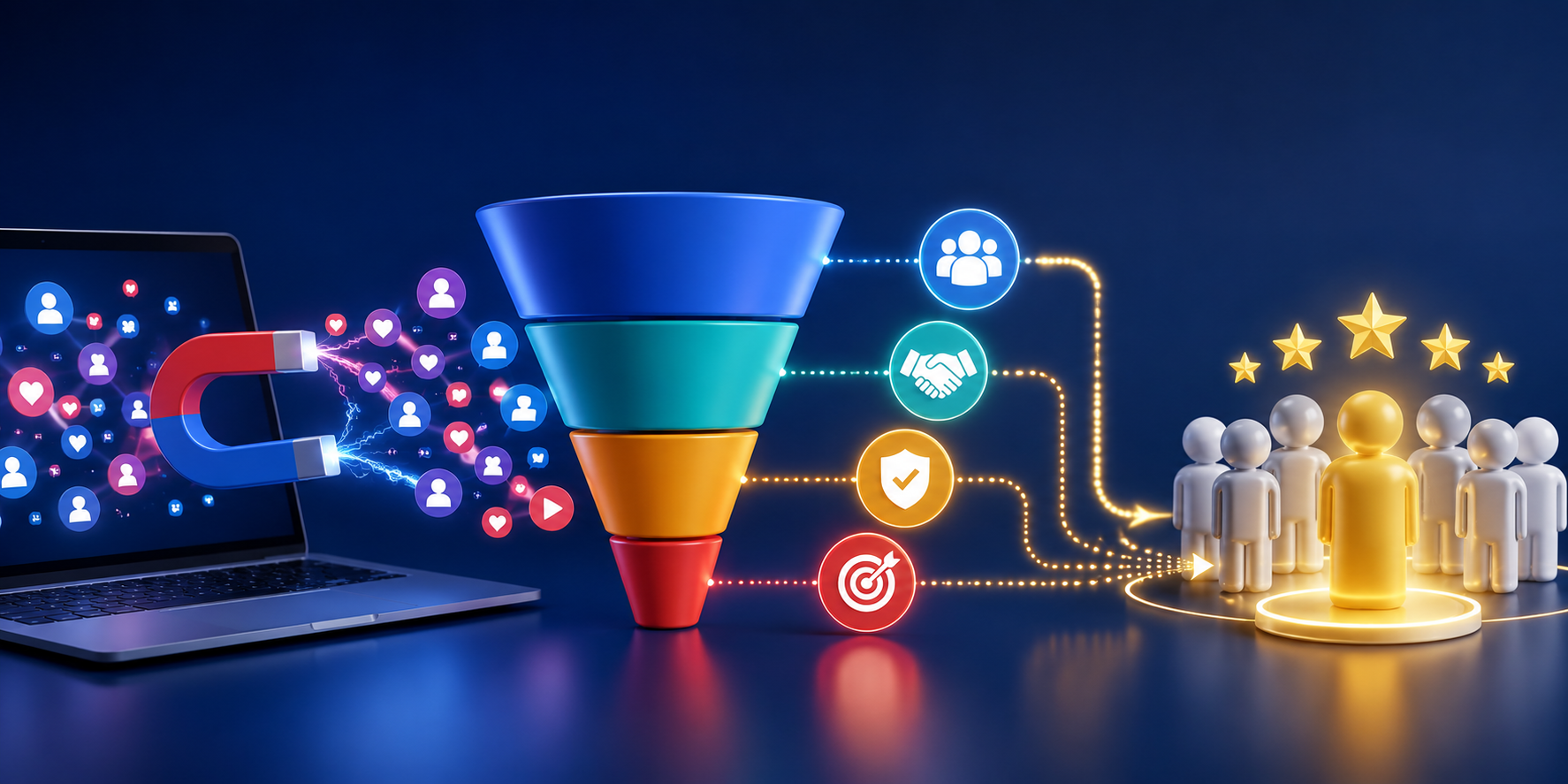
The Digital Marketing Gap: Why Good Brands Still Struggle to Get Customers
A business can have a beautiful website, thousands of social media followers, impressive videos, regular posts, and even strong search visibility — yet still struggle to generate customers.
This is one of the biggest challenges in modern digital marketing.
Businesses often focus heavily on getting attention. They want more views, more followers, more website visitors, more likes, and more reach.
But attention alone does not build a business.
The real challenge is turning that attention into interest, trust, enquiries, and eventually customers.
That gap between being noticed online and being chosen by a customer is the missing link in digital marketing.
Being Seen Is Only the Beginning
Imagine a business publishes a video that receives thousands of views.
The team celebrates the reach.
But after checking the results, they discover that almost nobody contacted the business.
Was the campaign successful?
It depends on the objective.
If the goal was awareness, the campaign may have performed well.
If the goal was generating customers, something is missing.
This is why businesses need to understand the difference between:
Visibility → Attention → Interest → Trust → Action → Customer
Getting people to notice your brand is only the first step.
Why Online Attention Doesn't Always Become Business
There are several reasons why people may see your brand but never become customers.
They may:
- Not understand what you offer
- Not see the value of your product
- Not trust the business yet
- Be outside your target audience
- Find the content interesting but irrelevant
- Have no reason to take action
- Face a confusing website
- Find no clear contact option
- Need more information before making a decision
The problem is therefore not always the amount of traffic.
Sometimes the problem is what happens after the traffic arrives.
The Difference Between Reach and Relevance
A large audience is not necessarily a valuable audience.
For example, a business might receive 100,000 views from people who have no interest in its services.
Another campaign might receive only 10,000 views but reach people actively looking for that service.
The second campaign may generate more enquiries.
This is why digital marketing should focus on relevant attention, not just large numbers.
Know Who You Want to Reach
Before creating content, businesses should understand their ideal customers.
Important questions include:
- Who are they?
- What problems do they have?
- What are they searching for?
- What motivates them?
- What stops them from purchasing?
- Which platforms do they use?
- What type of information do they trust?
Understanding the audience allows businesses to create marketing messages that feel relevant rather than generic.
Good Content Needs a Business Purpose
Content is one of the most important parts of digital marketing.
But creating content simply because a business needs to “post something†is not a strategy.
Every piece of content should have a purpose.
It might be designed to:
- Create awareness
- Educate customers
- Build trust
- Demonstrate expertise
- Generate enquiries
- Promote a product
- Introduce a service
- Retain existing customers
A good content strategy connects these different objectives.
Content Should Answer Customer Questions
Customers often begin their journey with questions.
They may search:
“Which digital marketing service does my business need?â€
“How can I get more customers online?â€
“Why is my website not generating leads?â€
“How much does digital marketing cost?â€
Businesses that answer these questions through blogs, videos, social media posts, and guides can become part of the customer's research process.
This creates an opportunity to build trust before asking for a sale.
SEO Helps Customers Find You
Search Engine Optimization plays an important role in the customer discovery process.
A potential customer may never know your business exists until they search for a problem or service.
SEO can help your content appear when people search for relevant information.
But modern SEO should not focus only on inserting keywords.
It should focus on:
- Search intent
- Helpful content
- Topic relevance
- Website experience
- Technical performance
- Clear information
- Internal linking
- Authority
- User needs
The goal is to help the right people discover your business.
Social Media Creates the First Connection
Social media can introduce a business to people who may never have searched for it directly.
A customer might discover a brand through:
- Instagram Reels
- Facebook posts
- YouTube Shorts
- LinkedIn content
- Product videos
- Educational content
- Behind-the-scenes posts
This first interaction can create awareness.
But businesses need to provide a path from that first interaction toward deeper engagement.
From Social Media to Website
A social media user may watch a video and become interested.
What happens next?
If the profile provides a clear website link, service information, portfolio, or contact option, the customer can continue the journey.
Without a next step, the opportunity may disappear.
This is why every digital channel should connect with the others.
Video Can Create Attention Quickly
Video is particularly effective at attracting attention because it combines:
- Visuals
- Movement
- Sound
- Storytelling
- Emotion
Businesses can use video for:
- Product demonstrations
- Brand stories
- Customer testimonials
- Educational content
- Reels
- Promotional campaigns
- Behind-the-scenes content
But video should not be created only to generate views.
The content should have a purpose within the broader customer journey.
Trust Is the Missing Middle
One of the most important steps between attention and purchase is trust.
Customers may discover your business today but may not buy from you immediately.
They may investigate:
- Reviews
- Testimonials
- Portfolio
- Website
- Social media
- Customer experiences
- Case studies
- Business information
This is why businesses need to build credibility across multiple digital touchpoints.
Customer Reviews Matter
Reviews provide social proof.
When potential customers see genuine positive experiences from previous customers, uncertainty can decrease.
Businesses should encourage satisfied customers to provide honest feedback and respond professionally to both positive and negative reviews.
Reviews should be genuine.
Artificial or manipulated reviews can damage credibility.
Case Studies Show What You Can Actually Do
A business can say:
“We deliver great results.â€
But a case study can demonstrate how.
A strong case study can show:
Challenge → Strategy → Execution → Outcome
This gives potential customers something concrete to evaluate.
For digital marketing businesses, case studies can demonstrate:
- Improved visibility
- Increased enquiries
- Better engagement
- Successful campaigns
- Content growth
- Lead-generation improvements
Your Website Must Continue the Story
Imagine someone discovers your business through an Instagram video.
They visit your website.
But the website is difficult to navigate, confusing, outdated, or doesn't clearly explain the service.
The customer may leave.
This shows why every digital touchpoint needs to deliver a consistent experience.
Your:
Ad → Social Profile → Website → Landing Page → Enquiry Form
should communicate a connected message.
Make Your Value Clear
Customers need to understand why they should choose your business.
A website or landing page should quickly communicate:
- What you offer
- Who you help
- What problem you solve
- What makes you different
- Why customers should trust you
- What they should do next
If customers have to search through multiple pages to understand the offer, you may lose their attention.
The Importance of a Strong Call-to-Action
A customer may be interested but still not know what to do.
A clear call-to-action can guide them.
Examples include:
- Request a consultation
- Get a quotation
- Talk to our team
- Book a meeting
- Send an enquiry
- Visit our service page
- Contact us on WhatsApp
The CTA should match the customer's level of interest.
Someone reading an educational blog may prefer “Learn more†rather than an aggressive “Buy now.â€
Make the Customer Journey Simple
The more complicated the journey, the greater the chance of losing potential customers.
A simple journey could be:
Social Media → Website → Service Page → Enquiry
Or:
Google Search → Blog → Service Page → Contact Form
Or:
Video → WhatsApp → Consultation
The exact journey depends on the business.
The important thing is to remove unnecessary friction.
Digital Advertising Can Bring Targeted Attention
Paid advertising can help businesses reach specific audiences.
Businesses can use advertising to promote:
- Products
- Services
- Offers
- Events
- Lead-generation campaigns
- Brand campaigns
However, advertising alone cannot fix a weak customer journey.
If an advertisement attracts people but the landing page fails to convince them, the campaign may waste money.
This is why ad creative, targeting, offer, landing page, and conversion process need to work together.
Why Some Ads Get Clicks but No Leads
A campaign might receive many clicks but few enquiries.
Possible reasons include:
- Wrong audience
- Weak offer
- Poor landing page
- Unclear message
- Low trust
- Complicated enquiry process
- No strong CTA
- Misleading advertisement
The solution is not always to increase the advertising budget.
Sometimes the customer journey needs to be improved.
Personalization Can Improve Relevance
Customers respond differently depending on their needs.
A business serving multiple industries can create different content for different audiences.
For example:
- Marketing for restaurants
- Marketing for educational institutions
- Marketing for healthcare businesses
- Marketing for real estate
- Marketing for professional services
When content reflects the customer's situation, it can feel more relevant.
AI Search Is Creating New Discovery Opportunities
Customers are also beginning to use AI-powered search experiences to research businesses, products, services, and solutions.
Instead of entering a short keyword, they may ask detailed questions.
This creates another opportunity for businesses to build visibility through:
- Helpful articles
- FAQs
- Expert content
- Original insights
- Clear service information
- Strong online reputation
- Consistent business information
The objective is not simply to appear in an AI answer.
It is to build a digital presence that clearly demonstrates relevance and expertise.
Don't Focus on One Digital Channel
The strongest digital marketing strategies often combine multiple channels.
For example:
SEO brings search visibility.
Social media creates engagement.
Video captures attention.
Content marketing builds expertise.
Advertising expands targeted reach.
Email marketing nurtures prospects.
Reviews build trust.
Landing pages support conversion.
Each channel can contribute to a different stage of the customer journey.
Measure What Actually Matters
Businesses should look beyond vanity metrics.
Likes and followers can be useful indicators, but they don't always represent business growth.
Important metrics can include:
- Qualified leads
- Enquiries
- Conversion rate
- Cost per lead
- Website actions
- Consultation bookings
- Sales
- Customer acquisition cost
- Return on advertising spend
The right metrics depend on the business objective.
Connect Marketing Data With Business Results
Marketing teams should understand what happens after a lead is generated.
For example:
100 Leads → 40 Qualified Leads → 15 Proposals → 7 Customers
This gives the business a much better understanding of marketing performance.
Generating leads is important, but generating qualified leads that become customers is even more valuable.
Why Some Businesses Get Attention but Stay Stuck
A business may have:
- Good branding
- Professional content
- Social media activity
- Website traffic
- Paid advertising
and still struggle with sales.
The missing piece may be the connection between these activities.
Marketing should not operate as separate pieces.
Instead, it should work as a connected system.
Content attracts.
SEO helps people discover.
Social media engages.
Proof builds trust.
Websites explain.
CTAs encourage action.
Sales converts.
That is the connection businesses need to build.
Common Digital Marketing Mistakes
Chasing Views Instead of Customers
High reach does not automatically mean high sales.
Targeting Everyone
Marketing becomes weaker when there is no clear audience.
Creating Content Without a Journey
Content should connect with a meaningful next step.
Ignoring the Website
A strong social media presence cannot completely compensate for a poor website experience.
Using Weak Calls-to-Action
Interested customers need clear direction.
Focusing Only on One Platform
Customers can discover businesses through many channels.
Measuring Only Vanity Metrics
Followers and likes don't tell the entire business story.
Expecting Immediate Results
Building visibility, trust, and authority takes time.
How to Connect Online Attention With Real Customers
Businesses can follow a simple framework.
1. Attract
Use SEO, social media, video, advertising, and content to reach relevant audiences.
2. Engage
Give people useful or interesting information.
3. Educate
Help them understand their problem and possible solutions.
4. Build Trust
Use reviews, case studies, testimonials, and expertise.
5. Convert
Provide a clear and simple way to enquire or purchase.
6. Nurture
Continue communicating with interested prospects.
7. Measure
Track the journey from attention to actual business results.
The Future of Digital Marketing Is About Connections
Digital marketing is no longer simply about getting people to see your brand.
It is about connecting different parts of the customer journey.
A customer may first see a Reel.
Then they may search Google.
Later, they may read a blog.
They may look at reviews.
They may visit your website.
Finally, they may send an enquiry.
Every interaction contributes to their decision.
This is why businesses need to think about the entire journey rather than individual marketing activities.
Conclusion
The biggest digital marketing challenge is not always getting attention.
It is turning that attention into something valuable.
A view becomes valuable when it creates interest.
Interest becomes valuable when it builds trust.
Trust becomes valuable when it leads to action.
And action becomes valuable when it creates a real customer.
That is the missing link between online attention and business growth.
A successful digital marketing strategy connects SEO, content marketing, social media, video, branding, advertising, customer reviews, websites, AI search, and lead generation into one customer-focused journey.